 What was the order of operations when it came to installing the facing stones on the large pyramids of the Fourth Dynasty? Were they just ornamental or did they serve a larger purpose in the engineering of the pyramids themselves? Was there a difference between how the rare instances of granite facing stones were installed and the Tura limestone facing blocks still visible on parts of the pyramids today? Join us as we probe the thoughts of a man who spends more time systematically and scientifically studying the large pyramids than any other person alive, Jean-Pierre Houdin.
Archive for the ‘Pyramids’ Category
 Sarah Korcz, a senior at Community Montessori School in New Albany, Indiana, and an aspiring Egyptologist, has shared several of her Egyptological research papers with me, and expressed an interest in doing an article for Em Hotep. Since we were about due for a catch-up session with Jean-Pierre Houdin, and I knew from some of our conversations that Sarah is keenly interested in Jean-Pierre’s work with pyramids, I asked her if she would like to interview him for the website. She was quite happy to oblige.
 The Djedi Project is not just the new mission to explore the pyramid shafts—it truly is the next generation in robotic archaeology. Beginning with Waynman Dixon’s iron rods, researchers have been probing the Great Pyramid’s mysterious claustrophobic passageways for 140 years. But now, using technology designed for uses as divergent as space exploration and terrestrial search and rescue, we are finally able to explore the chamber behind Gantenbrink’s Door.
Picking up where we left off with Pyramid Rover, this Em Hotep exclusive covers how the Djedi Team won the “Robot Olympics in the Desert”, the members who make up the team, the specifics of the robot’s design, and the results of Djedi’s maiden voyage up QCS and into the chamber behind the first blocking stone. Through interviews and exchanges with the Djedi Project manager, Shaun Whitehead, as well as other team members, this article promises to be the resource for the published Djedi material to date.
 One year ago today Em Hotep was present for the premier of Khufu Reborn at la Géode in Paris, France. Phase Two of Jean-Pierre Houdin’s work with the Great Pyramid of Khufu was revolutionary, but was preceded by another revolution in Egypt just two days prior. Now, on the one year anniversary of Khufu Reborn, we visit with Jean-Pierre to ask a few questions about his work, the impact of the January Revolution, and where we go from here.
 Last May the Project Djedi Team caught the world’s attention, and imagination, when they announced that the robot crawler designed to explore the southern shaft leading out of the Queen’s Chamber of the Great Pyramid had transmitted back images of markings left behind by the pyramid’s builders. Hidden behind a “door” that had either thwarted or limited previous attempts to investigate the shaft, the markings prompted much speculation about their nature and purpose.
The Djedi Project was back in the headlines at the end of December when New Scientist magazine named the discovery one of the Top 10 Science Stories of 2011. For the next few articles, Em Hotep will bring you up to date on the history of the exploration of the mysterious shafts in the Great Pyramid. This current article will cover the ground from Waynman Dixon up to the Pyramid Rover Project, with the next article focusing exclusively on Project Djedi. This will be followed by a couple of very special interviews you will not want to miss..
 It has been nearly a year now since architect Jean-Pierre Houdin premiered the second phase of his work with the Great Pyramid—Khufu Reborn. How has his work been received so far? Where does the project stand at the moment? Has the Arab Spring affected the progress of Project Khufu? Where do we go from here?
My good friend Marc Chartier of Pyramidales (and more recently of Égypte-actualités, but more on that endeavor later..) had a chance to sit down recently with Jean-Pierre and discuss these questions and more. Thanks to Em Hotep’s partnership with Pyramidales, I am able to bring you the English language version of this interview. Enjoy, and please feel free to join the conversation, as they say…
 If you weren’t able to make it to the premier of Khufu Reborn, the second episode of Jean-Pierre Houdin’s theory of how the Great Pyramid of Khufu was built, then you are in luck—the full presentation is now available on the web, courtesy of Dassault Systèmes! This isn’t just a dry lecture with some slides, this is the full 3D presentation, with narration.
In addition to providing the full simulation illustrating Jean-Pierre’s theory in detail, the Khufu Reborn universe is interactive. You can actually navigate you way around the Giza Plateau of 4,500 years ago. But if you aren’t ready to dive into Khufu’s world just yet, this Em Hotep tour and tutorial will equip you for the journey.
 Last week the news about the preliminary findings of the Djedi Project broke worldwide, and not without a little sensationalism. While sensationalism can be fun, it can also backfire when people form preconceived notions about what the findings mean.
“Red-painted numbers and graffiti are very common around Giza,” advises Peter Der Manuelian, an Egyptologist at Harvard University and director of the Giza Archives at the Museum of Fine Arts, Boston. “They are often masons’ or work-gangs’ marks, denoting numbers, dates or even the names of the gangs.”
There is a lot to be excited about with the Djedi mission, but we need to keep the discoveries in context until Egyptologists have had an opportunity to analyze the findings and their implications. But that does not mean that we can’t have some fun in the meanwhile…
 Follow Pharaoh Khufu’s funeral procession into the Great Pyramid where we learn the layout of the two very different routes to the King’s Chamber—one used by the workers in the construction of the vast monument, and one created for the sole purpose of the king’s last journey from his Valley Temple to the burial room.
This is the seventh article in a series based on Marc Chartier’s discussions with Jean-Pierre Houdin following the premier of Khufu Reborn, the long awaited revelation of the second chapter of Project Khufu. These articles are provided in English to Em Hotep via special arrangement with Marc Chartier/Pyramidales, Jean-Pierre Houdin and the Project Khufu team at Dassault Systèmes.
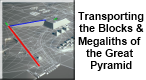
 Jean-Pierre Houdin’s theory of the how the Great Pyramid was built continues to unfold. How were the sixty-ton megalithic beams moved from the harbor at the base of the Giza Plateau to 43+ meters high into the Great Pyramid? Was there a second counterweight system like the one in the Grand Gallery? Why was Khafre’s Royal Causeway so wide?
In this, the sixth in a series of articles and interviews from Pyramidales writer Marc Chartier, we learn some of the key evolutions in Jean-Pierre Houdin’s theory. In the few short years between Khufu Revealed and Khufu Reborn, researcher/architect Houdin has expanded his work to account for anomalies surrounding the pyramid of Khufu’s successor, Pharaoh Khafre, and what they tell us about Khufu’s pyramid.
The English-language version of this article was very kindly provided by Marc Chartier, Jean-Pierre Houdin, and the Project Khufu team at Dassault Systèmes exclusively for Em Hotep readers.
 One of the most contested aspects of the architecture of the Great Pyramid is the function of the relieving compartments (or chambers) stacked above the King’s Chamber. Do they serve a strictly symbolic purpose? Do they represent, as has been suggested, the Djed Pillar, or some other sacred configuration? Or do they serve a structural purpose, despite adding seemingly unnecessary weight atop the King’s Chamber?
French architect Jean-Pierre Houdin sees the answer in the arrangement of internal elements of the pyramid’s architecture still hidden from plain view, but discernable by other architectural and material oddities, such as the relieving compartments themselves. Why were they so high? What purpose did raising the pressure points serve?
This is the fifth in a series of fascinating dialogues held between writer Marc Chartier, of the website Pyramidales, and Jean-Pierre Houdin following the premier of Khufu Reborn, the next chapter in the unraveling the mysteries of the Great Pyramid and the Giza Plateau. This series of articles is being provided in English for Em Hotep in an exclusive arrangement with Marc, Jean-Pierre, and the Project Khufu team at Dassault Systèmes.
 Is there a second, as of yet unopened, entrance to the King’s Chamber in the Great Pyramid? How did the ancient builders seal the burial chamber? Measuring the entrance that we do know about suggests that the sealing block would have fit into the entrance like a cork, but this cork was made to plug the neck from within the bottle. In other words, the sealing block could only have been closed from within the King’s Chamber.
So who pushed the block into place, when did they do it, and how did they get out? Human sacrifice within royal tombs had not been practiced since the early years of the Second Dynasty, so, cork or no cork, ultimately the King’s Chamber had to be sealed from the outside. How do we reconcile this contradiction?
This is the fourth in a series of articles and interviews conducted by Marc Chartier, writer and webmaster of the French-language site Pyramidales, with Jean-Pierre and other key members of Team Khufu, provided in English exclusively to Em Hotep.
29
Apr
Khufu’s Inheritance: Jean-Pierre Houdin Discusses the Noble Circuit and Deciphering the Pyramid
 The legacy Pharaoh Snefru left to his heir, Khufu, included more than the crown and wealth of the Old Kingdom. Building on an architectural and engineering revolution that stretched at least as far back as Pharaoh Djoser’s Master Builder, Imhotep, Khufu’s own architect Hemiunu was determined to build a monument that would last the ages. To say the least, he was successful.
But erecting the final resting place of a god-king involved more than structural and aesthetic considerations. Hemiunu was creating sacred ground, and within Khufu’s holy mountain there were specific paths to be trodden and a celestial order of operations to be observed.
Beginning with the physical evidence from the pyramid, Jean-Pierre Houdin pieces these ancient traditions together in a way that suggests where to look and what to look for in unlocking the secrets of the Great Pyramid. This is the third in a series of articles and interviews conducted by Marc Chartier with Jean-Pierre and other key members of Team Khufu, provided in English exclusively to Em Hotep.
 Part Two of Marc Chartier’s interview with Jean-Pierre Houdin following the premier of Kheops Renaissance, the long-awaited Episode Two of Project Khufu. This interview is part of a series of articles that first appeared on the website Pyramidales, run by Marc Chartier. These exclusive English-language translations are provided to Em Hotep courtesy of Marc, Jean-Pierre Houdin, and Dassault Systèmes.
 Just hours before the premier of Kheops Renaissance (also called Khufu Reborn), Jean-Pierre Houdin granted an exclusive interview to fellow Egyptology blogger Marc Chartier, proprietor of the website Pyramidales. Timed for release immediately following the event, Marc’s interview is a perfect introduction to Episode Two and the Project Khufu material that will be forthcoming from both Pyramidales and Em Hotep.
Previously available only in French, this is the first official English language translation, made available through our partnership with Pyramidales and Dassault Systèmes. Over the next few weeks I will be publishing, in addition to Part Two of this interview, translations of additional material that is being very kindly provided by Marc, Jean-Pierre, and the Project Khufu team at Dassault Systèmes. This will allow me some time to get caught up and reoriented after having to take one of my infamous sabbaticals (sometimes life just shows up with a bag full of challenges, but all is well, Gentle Reader!).
Featured Series










Khufu Reborn Interactive

Great Sphinx
Egyptology Links
Special Project Clearinghouse


Categories
- Announcements (5)
- Egypt in the News (39)
- Locations (65)
- Lower Egypt (57)
- Avaris (1)
- Cairo (5)
- Memphis (1)
- Saqqara (8)
- The Giza Plateau (44)
- Upper Egypt (11)
- Abu Simbel (1)
- Aswan (1)
- Edfu (1)
- Luxor (1)
- Thebes (4)
- Valley of the Kings (6)
- Lower Egypt (57)
- Periods (70)
- Pre-Dynastic (3)
- Early Dynastic (1)
- Old Kingdom (47)
- 1st Intermediate (2)
- Middle Kingdom (4)
- 2nd Intermediate (3)
- New Kingdom (16)
- 3rd Intermediate (3)
- Late Period (4)
- Roman Period (1)
- Byzantine Period (1)
- Islamic Period (4)
- Modern Egypt (6)
- Structures (60)
- Mummies (15)
- Photo Essays (3)
- Vita Shemsi (5)
- Video Reviews (2)
- Uncategorized (2)
- Book Review (1)
- Em Hotep Digest (13)
- Exhibitions (2)
- Giza 3D (1)
- God's Wives of Amun (4)
- Military History (1)
- Queens (2)
Archives
- October 2018
- January 2018
- November 2017
- October 2017
- September 2017
- August 2017
- July 2017
- June 2017
- November 2015
- April 2014
- October 2013
- July 2013
- June 2013
- May 2013
- April 2013
- March 2013
- February 2013
- January 2013
- December 2012
- October 2012
- September 2012
- March 2012
- January 2012
- December 2011
- October 2011
- July 2011
- June 2011
- May 2011
- April 2011
- January 2011
- December 2010
- August 2010
- July 2010
- May 2010
- April 2010
- March 2010
- February 2010
- January 2010
- December 2009
- November 2009
- October 2009
- September 2009
- August 2009
- July 2009
- June 2009
Exclusive!








Giza 3D Interactive

Em Hotep on Facebook

Who's Online
- 0 Known Egyptophiless
- 9 Guest Egyptophiles
Dynasties
- Answers About the Great Sphinx
- Egyptology Internet Links
- Dynasties
- Predynastic
- First Dynasty
- Second Dynasty
- Third Dynasty
- Fourth Dynasty
- Fifth Dynasty
- Sixth Dynasty
- Seventh and Eighth Dynasties
- Ninth and Tenth Dynasties
- Eleventh Dynasty
- Twelfth Dynasty
- Thirteenth Dynasty
- Fourteenth Dynasty
- Fifteenth Dynasty
- Sixteenth Dynasty
- Seventeenth Dynasty
- Eighteenth Dynasty
- Nineteenth Dynasty
- Twentieth Dynasty
- Twenty-First Dynasty
- Twenty-Second Dynasty
- Twenty-Third Dynasty
- Twenty-Fourth Dynasty
- Twenty-Fifth Dynasty
- Twenty-Sixth Dynasty
- Twenty-Seventh Dynasty
- Twenty-Eighth Dynasty
- Twenty-Ninth Dynasty
- Thirtieth Dynasty
- Thirty-First Dynasty
- Thirty-Second Dynasty
- Thirty-Third Dynasty
- Djedi Project Media Clearinghouse
- Giza 3D Project Media Clearinghouse
- Media Clearinghouse-Under Construction
- Project Khufu Media Clearinghouse

