Archive for the ‘Periods’ Category

fsi-000What was the order of operations when it came to installing the facing stones on the large pyramids of the Fourth Dynasty?  Were they just ornamental or did they serve a larger purpose in the engineering of the pyramids themselves?  Was there a difference between how the rare instances of granite facing stones were installed and the Tura limestone facing blocks still visible on parts of the pyramids today?  Join us as we probe the thoughts of a man who spends more time systematically and scientifically studying the large pyramids than any other person alive, Jean-Pierre Houdin.

Read the rest of this article »

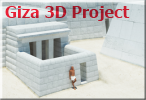
000 - tabGiza 3D is the virtual world of the Giza Plateau reconstructed from the thousands of archaeological photographs, first hand sketches of artifacts and monuments in situ, dig diaries, aerial and satellite imagery, and all the resources the Giza Archives have to offer, “a real-time virtual reconstruction of the Giza Plateau, based on actual archeological data gathered by Harvard and the Museum of Fine Arts, Boston (MFA) expeditions to Egypt in the first part of the 20th century” (Forbes: “How Harvard Students Explore Ancient Egypt From Cambridge With New 3D Technology”).

Here at Em Hotep we want to provide you with a set of travel guides to the virtual tours conducted by Peter Der Manuelian, where to go and what to see when you enter the free-style navigation mode that lets you wander around, and how to make the best of the many resources Giza 3D offers.  Join us for the first Travel Guide as we explore a series of three connected Fourth and Fifth Dynasty mastabas, the G 2100 Family Tomb Complex.

Read the rest of this article »

The more we learn about Hierakonpolis, the more likely it seems that during the Naqada II Period this ancient township was the capital of a province that reached well beyond its immediate boundaries. While it may be too early to call it a kingdom—we don’t know if the position of chieftain was hereditary or not—it was certainly headed in that direction.

Had consolidation been emphasized just a little more, and a tighter grip exercised over the northward expansion, Hierakonpolis might have become the capital of a united Egypt 500 years earlier than Narmer (Andelkovic, 2011, p. 29).  As it turned out, expansionism during Naqada II was more about the gradual assimilation of Lower Egypt, and consolidation was focused on three cities rather than just one—Hierakonpolis, Naqada, and Abydos.  But the roots of royalty were firmly established at Naqada II Hierakonpolis.

Read the rest of this article »

The unification of Egypt is credited to Narmer, the traditional first king of a unified Egypt, who extended his pharaonic mace from his capitol at Hierakonpolis to smite the backward villages of Lower Egypt and rein them in to southern ways.

Well, maybe not exactly.

The unification of Egypt was a process, not a historical event that can be neatly situated into a single time and place, much less a single person.  But one thing is for certain, that process began to take recognizable shape at Hierakonpolis and the earliest roots of that development began with the Badarian culture.  As we shall see in this article, the Naqadian people would build on the material culture of the Badarians, mostly through innovation and improvement of existing types, and this process would plant the seeds for pharaonic Egypt first at Hierakonpolis.  But as sometimes happens, we are getting ahead of ourselves.

Read the rest of this article »

Tausret: Forgotten Queen and Pharaoh of Egypt is a collaboration between Richard Wilkinson, who is Regent’ Professor of Egyptian Archaeology and Director of the Egyptian Expedition at the University of Arizona, and some of the most recognizable names in current Egyptology.

Written for a general audience, but with all the details a specialist looks for in a good book, Tausret is one of those books that will teach you about Egyptology while entertaining you with an adventure.  But it’s not the sort of swashbuckling adventure you might get with, say Belzoni.  It’s more of a detective story, spread out over a lot of detectives.

Read the rest of this article »

It would be easy to think that the ancient Egyptians, for all their amazing accomplishments in the arts and sciences, were morbidly obsessed with death.  After all, what do you think of when you imagine ancient Egypt?  The Pyramids:  tombs.  Tutankhamun:  a golden mummy.  Valley of the Kings: a cemetery.

But the truth of the matter is that the Egyptians were obsessed with life, and they fully expected it to continue on the Other Side.  Just as we work, save, and invest for our retirement today, the ancient Egyptians prepared for their eternal retirement amongst the gods.  Most of the art and artifacts connected to this planning, what we would call the funerary tradition and/or architecture, was considered to be the machinery of the afterlife, the tools and rituals required for the care and feeding of a departed spirit.

Read the rest of this article »

One year ago today Em Hotep was present for the premier of Khufu Reborn at la Géode in Paris, France. Phase Two of Jean-Pierre Houdin’s work with the Great Pyramid of Khufu was revolutionary, but was preceded by another revolution in Egypt just two days prior.  Now, on the one year anniversary of Khufu Reborn, we visit with Jean-Pierre to ask a few questions about his work, the impact of the January Revolution, and where we go from here.

Read the rest of this article »

Last week as news was breaking about the new tomb—KV64—Em Hotep received word from Stephen Cross, an Egyptologist and Geologist specializing in the Valley of the Kings, that he had photographed the tomb while conducting his own, unrelated research in the Valley.  Naturally, Steve held onto this wonderful shot until after the University of Basel had made their announcement.  Now that the whole world knows about KV64 and its lovely occupant, Steve has very kindly agreed to allow us to publish the photo, along with answer some questions about what is going on in the Valley of the Kings.

Inside:  Current projects in the Valley of the Kings, Steve’s meeting with the new head of the Supreme Council of Antiquities, and a picture of KV64 you will not see anywhere else!

Read the rest of this article »

In case you haven’t heard, there is a new addition to the list of tombs in the Valley of the Kings!  As I am currently focused on the next pyramid shaft article, and my multi-tasking cache already runneth over, I am pointing you to the sources I go to for information about such things—my brother and sister bloggers.


As always, these are not typical bloggers (have I mentioned how much I dislike that marginalizing term, blogger?), these are folks who are thoughtful, critical, analytical, and who often have direct channels to the primary sources.  Don’t forget to check out the comments sections, as this is where the story tends to develop.  And you have my word that these kind people will welcome your comments and questions as well.




(Kate gets two entries because VoK is her bailiwick)

It has been nearly a year now since architect Jean-Pierre Houdin premiered the second phase of his work with the Great Pyramid—Khufu Reborn.  How has his work been received so far?  Where does the project stand at the moment?  Has the Arab Spring affected the progress of Project Khufu?  Where do we go from here?

My good friend Marc Chartier of Pyramidales (and more recently of Égypte-actualités, but more on that endeavor later..) had a chance to sit down recently with Jean-Pierre and discuss these questions and more.  Thanks to Em Hotep’s partnership with Pyramidales, I am able to bring you the English language version of this interview.  Enjoy, and please feel free to join the conversation, as they say…

Read the rest of this article »

If you weren’t able to make it to the premier of Khufu Reborn, the second episode of Jean-Pierre Houdin’s theory of how the Great Pyramid of Khufu was built, then you are in luck—the full presentation is now available on the web, courtesy of Dassault Systèmes!  This isn’t just a dry lecture with some slides, this is the full 3D presentation, with narration.

In addition to providing the full simulation illustrating Jean-Pierre’s theory in detail, the Khufu Reborn universe is interactive.  You can actually navigate you way around the Giza Plateau of 4,500 years ago.  But if you aren’t ready to dive into Khufu’s world just yet, this Em Hotep tour and tutorial will equip you for the journey.

Read the rest of this article »

Last week the news about the preliminary findings of the Djedi Project broke worldwide, and not without a little sensationalism.  While sensationalism can be fun, it can also backfire when people form preconceived notions about what the findings mean.

“Red-painted numbers and graffiti are very common around Giza,” advises Peter Der Manuelian, an Egyptologist at Harvard University and director of the Giza Archives at the Museum of Fine Arts, Boston. “They are often masons’ or work-gangs’ marks, denoting numbers, dates or even the names of the gangs.”

There is a lot to be excited about with the Djedi mission, but we need to keep the discoveries in context until Egyptologists have had an opportunity to analyze the findings and their implications.  But that does not mean that we can’t have some fun in the meanwhile…

Read the rest of this article »

Follow Pharaoh Khufu’s funeral procession into the Great Pyramid where we learn the layout of the two very different routes to the King’s Chamber—one used by the workers in the construction of the vast monument, and one created for the sole purpose of the king’s last journey from his Valley Temple to the burial room.

This is the seventh article in a series based on Marc Chartier’s discussions with Jean-Pierre Houdin following the premier of Khufu Reborn, the long awaited revelation of the second chapter of Project Khufu.  These articles are provided in English to Em Hotep via special arrangement with Marc Chartier/Pyramidales, Jean-Pierre Houdin and the Project Khufu team at Dassault Systèmes.

Read the rest of this article »

Jean-Pierre Houdin’s theory of the how the Great Pyramid was built continues to unfold.  How were the sixty-ton megalithic beams moved from the harbor at the base of the Giza Plateau to 43+ meters high into the Great Pyramid?  Was there a second counterweight system like the one in the Grand Gallery?  Why was Khafre’s Royal Causeway so wide?

In this, the sixth in a series of articles and interviews from Pyramidales writer Marc Chartier, we learn some of the key evolutions in Jean-Pierre Houdin’s theory.  In the few short years between Khufu Revealed and Khufu Reborn, researcher/architect Houdin has expanded his work to account for anomalies surrounding the pyramid of Khufu’s successor, Pharaoh Khafre, and what they tell us about Khufu’s pyramid.

The English-language version of this article was very kindly provided by Marc Chartier, Jean-Pierre Houdin, and the Project Khufu team at Dassault Systèmes exclusively for Em Hotep readers.

Read the rest of this article »

One of the most contested aspects of the architecture of the Great Pyramid is the function of the relieving compartments (or chambers) stacked above the King’s Chamber.  Do they serve a strictly symbolic purpose?  Do they represent, as has been suggested, the Djed Pillar, or some other sacred configuration?  Or do they serve a structural purpose, despite adding seemingly unnecessary weight atop the King’s Chamber?

French architect Jean-Pierre Houdin sees the answer in the arrangement of internal elements of the pyramid’s architecture still hidden from plain view, but discernable by other architectural and material oddities, such as the relieving compartments themselves.  Why were they so high?  What purpose did raising the pressure points serve?

This is the fifth in a series of fascinating dialogues held between writer Marc Chartier, of the website Pyramidales, and Jean-Pierre Houdin following the premier of Khufu Reborn, the next chapter in the unraveling the mysteries of the Great Pyramid and the Giza Plateau.  This series of articles is being provided in English for Em Hotep in an exclusive arrangement with Marc, Jean-Pierre, and the Project Khufu team at Dassault Systèmes.

Read the rest of this article »