 In the Khufu’s Western Cemetery series, it is time to return to George Reisner. After losing support from the Hearst family in 1904, Reisner gained the support of Harvard University and the Museum of Fine Arts Boston and went on to spend many productive years on the Giza Plateau. The quantity of work Reisner produced during the Harvard/MFA years will require several installations in this series, but before resuming with biographies for our introductions, we will first examine the basic elements of mastabas. This is by no means exhaustive, but it is a good place to start.
Archive for the ‘Locations’ Category
 In this edition of the Khufu’s Western Cemetery series, we will introduce a chapter of mastabas with a brief biography of one of George Reisner’s valued colleagues, Tasmanian-born Egyptologist Arthur Cruttenden Mace. Mace migrated from work with Flinders Petrie at Abydos to join Reisner at Giza during the Hearst Expedition, and in this episode we will learn a little of his history and work. This is but a narrowed-down introduction, largely inspired and greatly informed by Gary Beuk‘s two-part series “Arthur Cruttenden Mace - Taking His Rightful Place,” Parts One and Two, hosted at Andie Byrnes and Kate Phizackerly‘s vast online journal, Egyptological. This is simply intended to tickle your curiosity about the prolific Egyptologist, and you are really should also read Gary Beuk’s two-part biography. The biographical portion is followed, as always, with a selection of largely interrelated mastabas from the HUMFA Expedition. As always, along with Beuk’s contribution, this series is reliant upon, inspirited by, and pleasurably dedicated to the Harvard University/Museum of Fine Arts Boston Giza Archives, currently in transition to Digital Giza.
 The next concession we will explore in the Western Cemetery is the German mission, the Sieglin Expedition. Founded by Georg Steindorff, much of the western strip was subsequently excavated by Hermann Junker. Along with Steindorff and Junker, we will also visit Ludwig Borchardt, whose notable presence began with the division of the concessions in 1902, when he stood in for Steindorff at the division of the concessions between the Americans, the Italians, and the Germans. The article will be followed by a representative look at mastabas from the Steindorff, Junker West, and Junker East sub-cemeteries.
 In the last edition of the Western Cemeteries we visited the field itself with George Reisner and the Hearst Expedition. We will be visiting Reisner quite a bit, later in this series, but this time we are going to look in particular at the Italian Turin Mission, led by Ernesto Schiaparelli. Schiaparelli is perhaps more associated with his discovery of the tomb of Nefertari in the Valley of the Queens, but he did receive the concession to explore the Western Cemetery for Italy, and he did do some work there. Let’s take a look.
Just a couple of notes beforehand. First, this edition is dedicated to my friend and G.P., Dr. Akshaya Patel, who had blessed me with good health, counsel, and conversation. I am a man of my word - Dr. Patel, this is for you. Second, as I am bringing the site back into current service, I am slowly approving and responding to literally hundreds of pending posts. Please be patient!
 We have examined how George Reisner developed his concept of the nucleus cemeteries, and how these grew into what we now call the Western Field, or, Western Necropolis. We have examined how the field was divided into three tracts so that concessions could be assigned to international missions. We will now begin looking at an assortment of the tombs themselves, beginning with George Reisner and the Hearst Expedition.
 We have been introduced to the Western Cemetery of Khufu, and how it began as nucleus cemeteries that expanded as additional mastabas and burials were added, creating the not-always-so-neat mosaic of a history in stone of the Fourth Dynasty, beginning with the reign of Pharaoh Khufu. Now the Egyptian authorities were going to allow three international missions to begin excavation in the Western Cemetery. But how would the concessions be divided? How was the decision made, as regards who digs where? In Part 3, we begin to demystify at least how this process began. As we go, we will see that concessions get passed on, swapped, and at least temporarily, set aside. The concessions at Giza today may look somewhat differently, but at least in the beginning of the Twentieth Century, this is how it started.
Read the rest of this article »
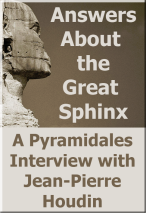
 With the support of architectural and topographic evidence, Jean-Pierre Houdin is convinced that the Giza Sphinx represents King Khufu.
For the last fifteen years, Jean-Pierre Houdin has considered the Giza Plateau to be an area particularly rich and fruitful for research. The architect has notably focused on the star of the site: the Great Pyramid, to which he has devoted an evolving theory, developed in Khufu Revealed, then in Khufu Reborn; these are two installments in the ongoing story of the reconstruction of the building site of this marvel of stone, which was largely echoed by Pyramidales.
Broadening his focus to the whole Giza Plateau, but without moving away from his “preferred” building site, Jean-Pierre Houdin came naturally to integrate in his research another major piece of the great jigsaw puzzle that the Giza site represents: the Sphinx. Jean-Pierre’s research into the Sphinx is guided by these two recurrent questions: What is the meaning of this colossal sculpture? To which King should it be tied?
Loyal to the techniques and teachings from his own profession as a builder, Jean-Pierre Houdin doesn’t take the risk of following the “traditional operating mode” of Egyptologists and other patented archaeologists.
Every man to his own trade…Jean-Pierre intends first of all, while taking into consideration the developments from those Egyptologists, to allow the topography of the Plateau to speak, examining how it evolved according to weather conditions and progress of building projects on the site such as the opening of quarries, the building of the ramps for the transport of materials, the construction of pyramids and in particular, the appearance of a certain…Sphinx!
At the end of the study, a conclusion will prevail: that the Sphinx is inseparable from Khufu. But let’s not get ahead of ourselves…
Jean-Pierre Houdin agreed to describe his development, exclusively for Pyramidales (French version) and Em Hotep (English version), through an interview conducted through an exchange of e-mails. With regards to the technical nature of the topic, this method was imperative. This explains the sometimes “didactic” nature of the answers which was required for clarity.
 Last week we published Part One of Marc Chartier’s interview with Jean-Pierre Houdin regarding the Great Sphinx. In that installment Jean-Pierre made the case for Khufu being the face which adorns the mighty guardian of the Memphis Necropolis. This week, in Part Two, we will be looking at the physical evidence for setting a date for the Sphinx’s construction. Enjoy!
 We have seen over the past weeks the case for the Great Sphinx having been constructed during the Fourth Dynasty in honor of Pharaoh Khufu, based on the evidence of the Plateau itself. In Part Three Jean-Pierre Houdin examines the evidence of other features of the Giza Plateau where the ancient builders seem to have labored to channel the water runoff that threatened their monuments.
 What was the order of operations when it came to installing the facing stones on the large pyramids of the Fourth Dynasty? Were they just ornamental or did they serve a larger purpose in the engineering of the pyramids themselves? Was there a difference between how the rare instances of granite facing stones were installed and the Tura limestone facing blocks still visible on parts of the pyramids today? Join us as we probe the thoughts of a man who spends more time systematically and scientifically studying the large pyramids than any other person alive, Jean-Pierre Houdin.
 Last year during the premiere of Giza 3D, Marc Chartier of Pyramidales and I had a chance to talk with Egyptologist Rus Gant, lead technical artist for the Giza Archives Project and Giza 3D. In transcribing presentations from last year, I came across this fascinating “lost” discussion, and after working with Rus and Marc to clarify some points, we can now present it in an interview format for your enjoyment. From the resources used to create Giza 3D to George Reisner’s ongoing legacy, join us for a chat with Rus Gant.
 Giza 3D is the virtual world of the Giza Plateau reconstructed from the thousands of archaeological photographs, first hand sketches of artifacts and monuments in situ, dig diaries, aerial and satellite imagery, and all the resources the Giza Archives have to offer, “a real-time virtual reconstruction of the Giza Plateau, based on actual archeological data gathered by Harvard and the Museum of Fine Arts, Boston (MFA) expeditions to Egypt in the first part of the 20th century” (Forbes: “How Harvard Students Explore Ancient Egypt From Cambridge With New 3D Technology”).
Here at Em Hotep we want to provide you with a set of travel guides to the virtual tours conducted by Peter Der Manuelian, where to go and what to see when you enter the free-style navigation mode that lets you wander around, and how to make the best of the many resources Giza 3D offers. Join us for the first Travel Guide as we explore a series of three connected Fourth and Fifth Dynasty mastabas, the G 2100 Family Tomb Complex.
 Tausret: Forgotten Queen and Pharaoh of Egypt is a collaboration between Richard Wilkinson, who is Regent’ Professor of Egyptian Archaeology and Director of the Egyptian Expedition at the University of Arizona, and some of the most recognizable names in current Egyptology.
Written for a general audience, but with all the details a specialist looks for in a good book, Tausret is one of those books that will teach you about Egyptology while entertaining you with an adventure. But it’s not the sort of swashbuckling adventure you might get with, say Belzoni. It’s more of a detective story, spread out over a lot of detectives.
 The Djedi Project is not just the new mission to explore the pyramid shafts—it truly is the next generation in robotic archaeology. Beginning with Waynman Dixon’s iron rods, researchers have been probing the Great Pyramid’s mysterious claustrophobic passageways for 140 years. But now, using technology designed for uses as divergent as space exploration and terrestrial search and rescue, we are finally able to explore the chamber behind Gantenbrink’s Door.
Picking up where we left off with Pyramid Rover, this Em Hotep exclusive covers how the Djedi Team won the “Robot Olympics in the Desert”, the members who make up the team, the specifics of the robot’s design, and the results of Djedi’s maiden voyage up QCS and into the chamber behind the first blocking stone. Through interviews and exchanges with the Djedi Project manager, Shaun Whitehead, as well as other team members, this article promises to be the resource for the published Djedi material to date.
 One year ago today Em Hotep was present for the premier of Khufu Reborn at la Géode in Paris, France. Phase Two of Jean-Pierre Houdin’s work with the Great Pyramid of Khufu was revolutionary, but was preceded by another revolution in Egypt just two days prior. Now, on the one year anniversary of Khufu Reborn, we visit with Jean-Pierre to ask a few questions about his work, the impact of the January Revolution, and where we go from here.
Featured Series









Khufu Reborn Interactive

Great Sphinx
Egyptology Links
Special Project Clearinghouse


Categories
- Announcements (5)
- Egypt in the News (39)
- Locations (65)
- Lower Egypt (57)
- Avaris (1)
- Cairo (5)
- Memphis (1)
- Saqqara (8)
- The Giza Plateau (44)
- Upper Egypt (11)
- Abu Simbel (1)
- Aswan (1)
- Edfu (1)
- Luxor (1)
- Thebes (4)
- Valley of the Kings (6)
- Lower Egypt (57)
- Periods (70)
- Pre-Dynastic (3)
- Early Dynastic (1)
- Old Kingdom (47)
- 1st Intermediate (2)
- Middle Kingdom (4)
- 2nd Intermediate (3)
- New Kingdom (16)
- 3rd Intermediate (3)
- Late Period (4)
- Roman Period (1)
- Byzantine Period (1)
- Islamic Period (4)
- Modern Egypt (6)
- Structures (60)
- Mummies (15)
- Photo Essays (3)
- Vita Shemsi (5)
- Video Reviews (2)
- Uncategorized (2)
- Book Review (1)
- Em Hotep Digest (13)
- Exhibitions (2)
- Giza 3D (1)
- God's Wives of Amun (4)
- Military History (1)
- Queens (2)
Archives
- October 2018
- January 2018
- November 2017
- October 2017
- September 2017
- August 2017
- July 2017
- June 2017
- November 2015
- April 2014
- October 2013
- July 2013
- June 2013
- May 2013
- April 2013
- March 2013
- February 2013
- January 2013
- December 2012
- October 2012
- September 2012
- March 2012
- January 2012
- December 2011
- October 2011
- July 2011
- June 2011
- May 2011
- April 2011
- January 2011
- December 2010
- August 2010
- July 2010
- May 2010
- April 2010
- March 2010
- February 2010
- January 2010
- December 2009
- November 2009
- October 2009
- September 2009
- August 2009
- July 2009
- June 2009
Exclusive!






Giza 3D Interactive

Em Hotep on Facebook

Who's Online
- 0 Known Egyptophiless
- 10 Guest Egyptophiles
Dynasties
- Answers About the Great Sphinx
- Egyptology Internet Links
- Dynasties
- Predynastic
- First Dynasty
- Second Dynasty
- Third Dynasty
- Fourth Dynasty
- Fifth Dynasty
- Sixth Dynasty
- Seventh and Eighth Dynasties
- Ninth and Tenth Dynasties
- Eleventh Dynasty
- Twelfth Dynasty
- Thirteenth Dynasty
- Fourteenth Dynasty
- Fifteenth Dynasty
- Sixteenth Dynasty
- Seventeenth Dynasty
- Eighteenth Dynasty
- Nineteenth Dynasty
- Twentieth Dynasty
- Twenty-First Dynasty
- Twenty-Second Dynasty
- Twenty-Third Dynasty
- Twenty-Fourth Dynasty
- Twenty-Fifth Dynasty
- Twenty-Sixth Dynasty
- Twenty-Seventh Dynasty
- Twenty-Eighth Dynasty
- Twenty-Ninth Dynasty
- Thirtieth Dynasty
- Thirty-First Dynasty
- Thirty-Second Dynasty
- Thirty-Third Dynasty
- Djedi Project Media Clearinghouse
- Giza 3D Project Media Clearinghouse
- Media Clearinghouse-Under Construction
- Project Khufu Media Clearinghouse

