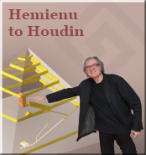
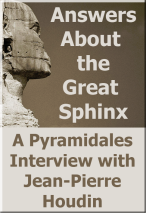
With the support of architectural and topographic evidence, Jean-Pierre Houdin is convinced that the Giza Sphinx represents King Khufu.
For the last fifteen years, Jean-Pierre Houdin has considered the Giza Plateau to be an area particularly rich and fruitful for research. The architect has notably focused on the star of the site: the Great Pyramid, to which he has devoted an evolving theory, developed in Khufu Revealed, then in Khufu Reborn; these are two installments in the ongoing story of the reconstruction of the building site of this marvel of stone, which was largely echoed by Pyramidales.
Broadening his focus to the whole Giza Plateau, but without moving away from his “preferred” building site, Jean-Pierre Houdin came naturally to integrate in his research another major piece of the great jigsaw puzzle that the Giza site represents: the Sphinx. Jean-Pierre’s research into the Sphinx is guided by these two recurrent questions: What is the meaning of this colossal sculpture? To which King should it be tied?
Loyal to the techniques and teachings from his own profession as a builder, Jean-Pierre Houdin doesn’t take the risk of following the “traditional operating mode” of Egyptologists and other patented archaeologists.
Every man to his own trade…Jean-Pierre intends first of all, while taking into consideration the developments from those Egyptologists, to allow the topography of the Plateau to speak, examining how it evolved according to weather conditions and progress of building projects on the site such as the opening of quarries, the building of the ramps for the transport of materials, the construction of pyramids and in particular, the appearance of a certain…Sphinx!
At the end of the study, a conclusion will prevail: that the Sphinx is inseparable from Khufu. But let’s not get ahead of ourselves…
Jean-Pierre Houdin agreed to describe his development, exclusively for Pyramidales (French version) and Em Hotep (English version), through an interview conducted through an exchange of e-mails. With regards to the technical nature of the topic, this method was imperative. This explains the sometimes “didactic” nature of the answers which was required for clarity.
Read the rest of this article »
Tags: Great Sphinx, Jean-Pierre Houdin, Marc Chartier
 Last week we published Part One of Marc Chartier’s interview with Jean-Pierre Houdin regarding the Great Sphinx. In that installment Jean-Pierre made the case for Khufu being the face which adorns the mighty guardian of the Memphis Necropolis. This week, in Part Two, we will be looking at the physical evidence for setting a date for the Sphinx’s construction. Enjoy!

 Almost everybody knows what the Great Sphinx of Giza is, but how much do we really know about it? In this article we will be looking at the role of sphinxes in Egyptian mythology—what they are, what they mean, and what they did. We will also be taking an in depth look at the history of the Great Sphinx. Who may have built it and why? When was it built? Do we really know?
 Valley temples were not just the entrance point to pyramid complexes, they were the connection to the Nile River-the eternal source of life for Egypt. Architectural genius, incredible feats of engineering, and a huge workforce whose actions were as choreographed as any ballet were all required to assure that the Boats of the Gods had access to Khafre’s pyramid complex. For the Ancient Egyptians, preparation for the afterlife was serious business.
 The second pyramid built on the Giza Plateau, and the second largest in Egypt, Khafre’s Pyramid takes advantage of its superior location to steal the limelight on the plateau.